Open-Source AI & Open Models Reading List
The Comprehensive Guide to Open-Source AI Models and API Integration The open-source AI models ecosystem is expanding faster than most teams can read. New

The Comprehensive Guide to Open-Source AI Models and API Integration
The open-source AI models ecosystem is expanding faster than most teams can read. New weights, licenses, inference providers, and evaluation suites appear weekly. This guide is a curated reading list for builders who need to move from curiosity to production without drowning in tabs. Whether you are integrating an open-source AI model API, comparing DeepSeek v3 API access, or evaluating managed inference, the goal is the same: make informed technical decisions quickly. Mydeepseekapi is one managed path that removes setup friction for teams that want DeepSeek v3 and r1 models. But the reading list below is broader: it covers models, APIs, papers, docs, communities, and production lessons.
How to Navigate This Open-Source AI & Open Models Reading List

Treat this as a map, not a checklist. Your role and urgency determine which sections to read first. A solo builder prototyping an idea needs different material than a platform lead assessing compliance risk. The fastest path is to pick your goal, skim the matching sections, and only then dive into papers or provider docs.
Who This Reading List Is For: Builders, Integrators, and Technical Leads
Developers integrating APIs should focus on API layers, SDK patterns, and error handling. ML engineers comparing open models need model families, benchmarks, and fine-tuning papers. Product teams evaluating cost should read pricing models, token economics, and production case studies. Technical leaders assessing risk should prioritize licensing, privacy, compliance, and provider deprecation policies.
How to Read by Goal: Prototype, Deploy, Optimize, Govern
For a quick prototype, read the API access and minimal call sections. For production deployment, study self-hosting versus managed API, monitoring, and fallback models. For optimization, go deep on quantization, distillation, speculative decoding, and latency benchmarks. For governance, start with open weights versus open source, acceptable use policies, and data retention.
Key Terms: Open Weights, Open Source, Open Model API, Managed Inference
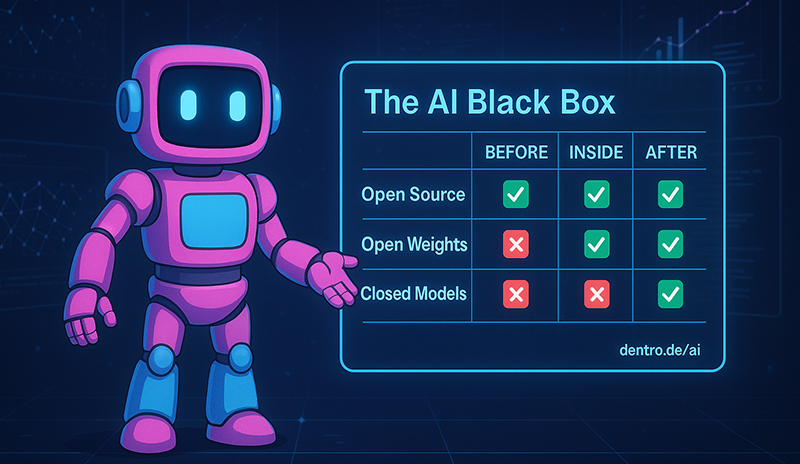
Open weights means model parameters are downloadable, but training data and code may not be. Open source usually implies a license that permits use, modification, and redistribution. An open model API exposes open models through a hosted endpoint. Managed inference means a provider runs the GPUs, scaling, and uptime for you. These definitions matter because they change your legal exposure and operational burden.
The Open-Source AI Model Landscape: What to Read First
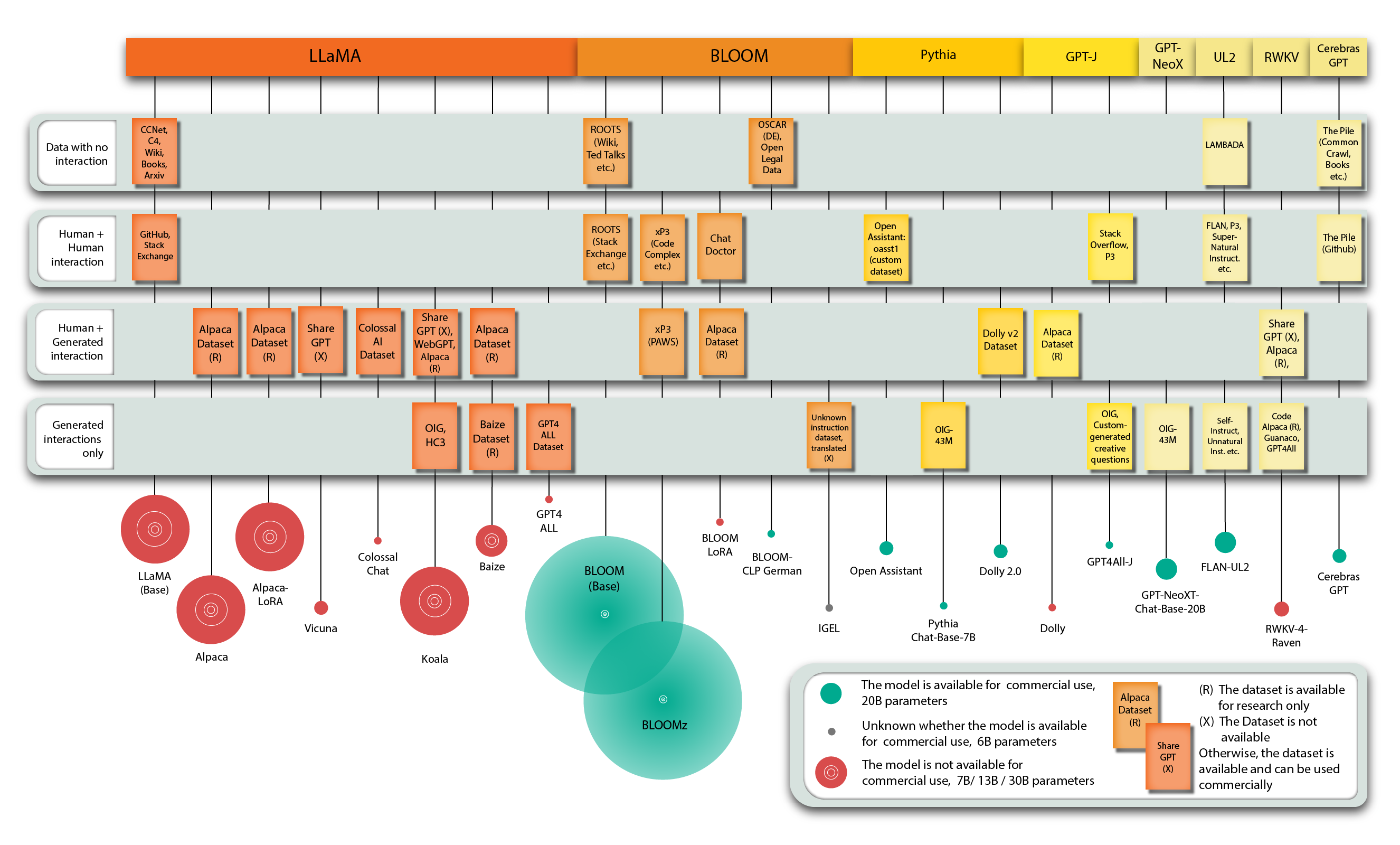
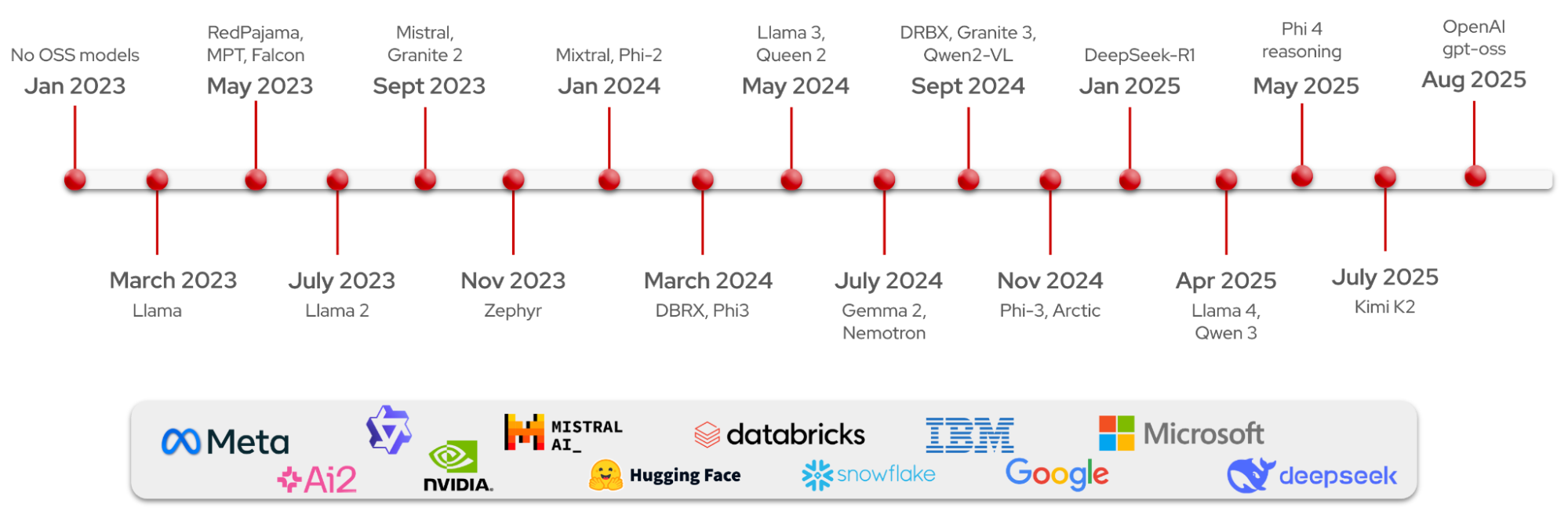
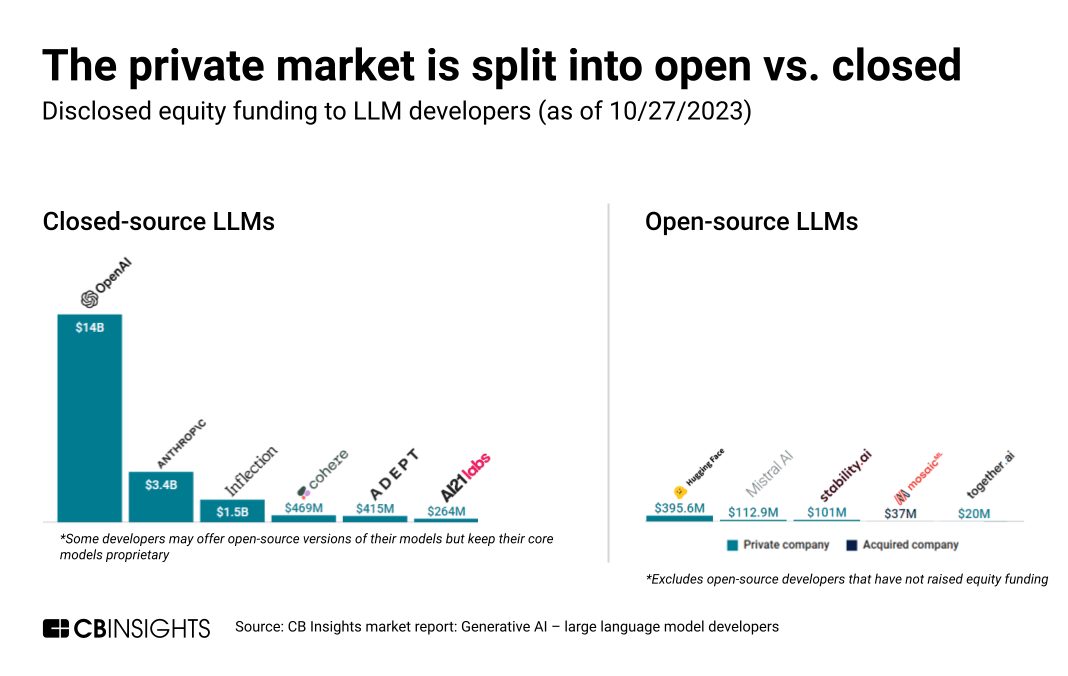
The open-source AI model landscape is not a single community. It is a mix of corporate labs, research groups, and community forks. Read broadly enough to understand trade-offs, then narrow to the families that match your task. The best reading list includes model cards, license files, benchmark reports, and independent evaluations.
Open Weights vs Open Source vs Source-Available
Open weights give you access to parameters, but they may restrict commercial use or require attribution. Open source adds freedoms to inspect, modify, and redistribute training code and data. Source-available is often a middle ground: you can read the code, but the license may limit competitive use. For production, always read the actual license text, not the marketing page.
Major Model Families: Llama, Mistral, Qwen, DeepSeek, Gemma, Falcon
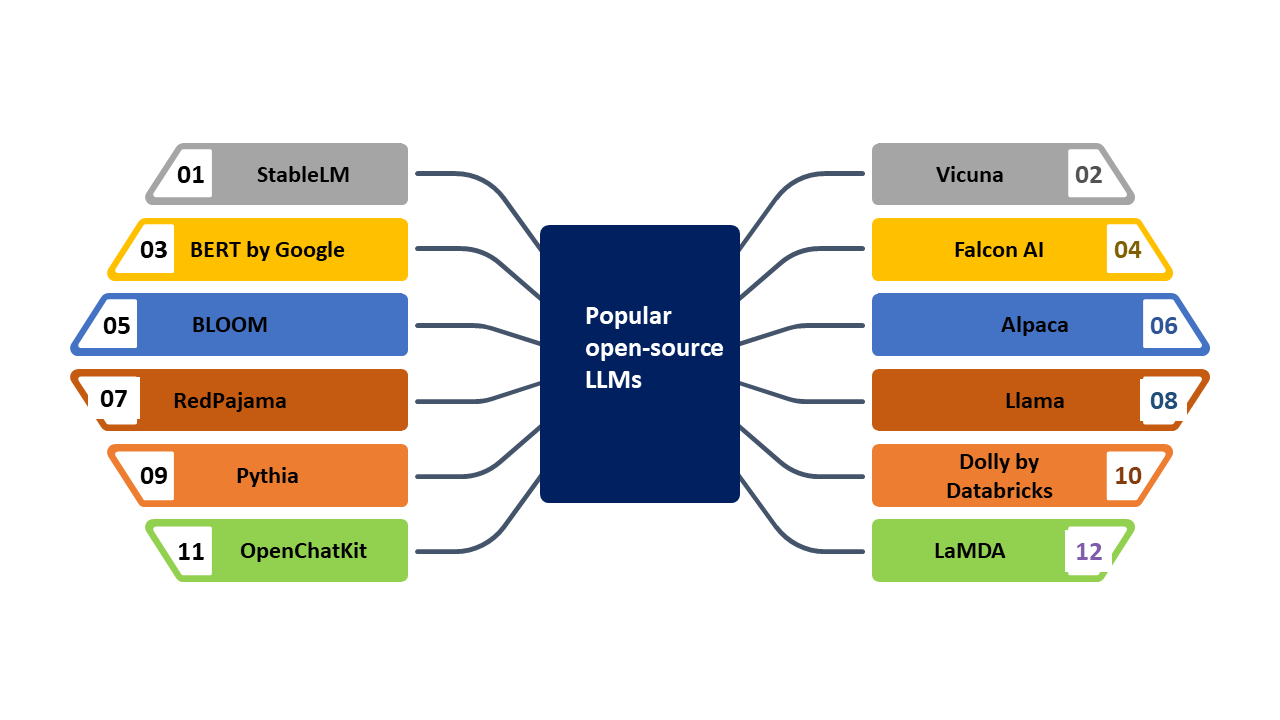
Llama is known for broad ecosystem support and strong community tooling. Mistral focuses on efficiency and strong performance per parameter. Qwen has deep multilingual and coding capabilities. DeepSeek stands out for reasoning and efficiency, especially in the v3 and r1 lines. Gemma emphasizes lightweight deployment, while Falcon has been used in research and enterprise pilots. Match the family to your latency, language, and reasoning needs.
Benchmarks, Leaderboards, and Evaluation Repositories
Do not trust a single leaderboard. Read the methodology, dataset contamination checks, and evaluation prompts. Prefer leaderboards that publish raw results and allow community submissions. Cross-check with your own evaluation set. A model that wins on MMLU may fail on your customer support transcripts or code review tasks.
Licensing and Commercial Use: A Reading Checklist
Check the license type, acceptable use policy, attribution requirements, redistribution limits, and whether derivative models can be released. Verify if the license changes with model size or commercial scale. Keep a copy of the license version you relied on. A common mistake is assuming “open weights” means “do anything,” which can create legal risk later.
Understanding Open-Source AI Model API Access
An open-source AI model API turns a downloadable model into a production service. Instead of managing GPUs, CUDA drivers, and autoscaling, you call an endpoint. The API layer adds authentication, rate limits, streaming, monitoring, billing, and versioning. This is often the fastest way to test open models without infrastructure overhead.
What an API Layer Adds to Open Models
A good API layer handles API keys, quotas, token counting, and streaming responses. It also provides model versioning so you can pin a version or roll forward. Monitoring and billing are not extras; they are how you control spend and debug failures. Without these, you are running a science experiment, not a production system.
Self-Hosting vs Managed API vs Hybrid Inference
| Approach | Control | Latency | Privacy | Ops burden | Best for |
|---|---|---|---|---|---|
| Self-hosting | Highest | Varies with hardware | Full control | High | Regulated data, custom fine-tunes |
| Managed API | Medium | Provider-optimized | Depends on provider | Low | Fast prototypes, scaling |
| Hybrid | High | Tunable | Split by workload | Medium | Sensitive + bursty workloads |
Self-hosting gives maximum control but requires GPU capacity and MLOps skills. Managed APIs reduce operational burden but shift privacy and uptime responsibility to the provider. Hybrid inference routes sensitive requests on-prem and burst traffic to a managed endpoint.
Criteria for Choosing an Open-Source AI Model API
Evaluate response time, transparent pricing, setup effort, model coverage, uptime guarantees, data privacy, and support. Also check rate limits, concurrency limits, and whether the provider exposes streaming and tool calling. A low headline price can hide retry costs, cold starts, or egress fees. Ask for a sample invoice before committing.
How DeepSeek v3 API Access Fits into a Production Stack
DeepSeek v3 API access fits chat assistants, RAG pipelines, coding helpers, and batch summarization. It is especially useful when you need strong reasoning without running your own inference cluster. Mydeepseekapi is an option with blazing-fast response times, transparent pricing, and zero setup hassle. In practice, that means your team can test DeepSeek v3 in an afternoon instead of a sprint.
DeepSeek Open Models Integration: A Practical Reading Path
DeepSeek open models integration deserves its own path because the v3 and r1 lines serve different needs. Read the model cards, API references, and community migration guides. Then test with real prompts before you commit to a provider or self-hosted deployment.
DeepSeek v3 vs DeepSeek r1: Capabilities, Context, and Cost
DeepSeek v3 is often chosen for balanced speed and quality across general tasks. DeepSeek r1 is oriented toward deeper reasoning, which can improve complex problem-solving but may cost more tokens. Compare context handling, latency, and cost per successful task. For chat and RAG, v3 may be enough; for math, planning, or code synthesis, r1 may justify the extra spend.
Integration Patterns: Streaming, Batch, Tool Calling, Embeddings
Streaming improves perceived latency in chat UIs. Batch works for offline summarization, classification, and document processing. Tool calling lets the model invoke functions, which is essential for agents and workflow automation. Embeddings are separate models used for retrieval. Read provider docs to confirm which patterns are supported and how they are billed.
Reading List for DeepSeek API Access and SDK Examples
Prioritize official API docs, SDK examples, migration guides, and community tutorials. Look for examples that cover authentication, streaming, error handling, and rate limits. A good SDK reduces boilerplate, but a bad one hides important failure modes. Mydeepseekapi positions itself as a zero-setup way to integrate DeepSeek v3 and r1 into existing workflows.
Common DeepSeek Integration Pitfalls and Mitigations
Watch for token limits, rate limits, prompt sensitivity, and model-version drift. Token limits can truncate context silently. Prompt sensitivity means small format changes can alter output quality. Model-version drift can break evaluations when the provider updates weights. Mitigate with pinned versions, retries with backoff, and a small regression suite before every upgrade.
Run Open-Source AI Models via API: Step-by-Step Reading List
If you want to run open-source AI models via API, follow a sequence. Start with constraints, choose a model and provider, prototype, evaluate, then scale. This order prevents the common trap of optimizing infrastructure before you know whether the model solves the problem.
Step 1: Define Task, Latency, and Cost Constraints
Write down the job to be done, acceptable p95 latency, and budget per request. For a chat assistant, sub-second first token may matter. For batch summarization, throughput matters more than latency. Cost constraints should include retries, prompt length, and output length. Without these numbers, provider selection becomes guesswork.
Step 2: Choose a Model and Provider
Match model strengths to your use case. A coding assistant may prefer a model with strong code benchmarks. A multilingual support bot may need broad language coverage. Compare managed providers on pricing, model coverage, uptime, and privacy. If you need DeepSeek models without infrastructure work, Mydeepseekapi is a candidate worth testing.
Step 3: Prototype with a Minimal API Call
Test authentication, prompt format, streaming, and error responses first. A minimal call looks like this:
curl https://api.example.com/v1/chat/completions \
  -H "Authorization: Bearer $API_KEY" \
  -H "Content-Type: application/json" \
  -d '{
    "model": "deepseek-v3",
    "messages": [{"role": "user", "content": "Explain MoE in one paragraph."}],
    "stream": true
  }'
Replace the endpoint and model name with your provider’s documented values. Verify how the API returns errors, rate-limit headers, and token usage.
Step 4: Evaluate Quality, Safety, and Throughput
Build a small evaluation set from real user requests. Measure accuracy, helpfulness, refusal behavior, and latency. Add guardrails for harmful or off-topic requests. Red-team with adversarial prompts before launch. Test concurrency to see how throughput degrades under load.
Step 5: Scale to Production with Monitoring
Log requests, responses, token counts, latency, and errors. Track cost per conversation or per document. Set up fallback models for provider outages. Alert on error-rate spikes and budget thresholds. Mydeepseekapi emphasizes fast response times and transparent pricing, which are useful criteria when comparing production readiness.
Essential Papers and Technical Reports for Open Models
Papers explain why models behave the way they do. They are not mandatory for every integration, but they help you debug strange outputs and choose better architectures. Read the foundational papers first, then follow the techniques that affect your cost or latency.
Architecture Papers: Transformers, MoE, Attention Variants
Start with “Attention Is All You Need” for transformers. Then read mixture-of-experts (MoE) papers to understand sparse activation and why some models are cheaper to serve. Attention variants like grouped-query attention reduce memory and improve inference speed. These papers explain trade-offs you will see in provider benchmarks.
Fine-Tuning and PEFT: LoRA, QLoRA, Adapters
LoRA and QLoRA allow parameter-efficient fine-tuning on smaller GPUs. Adapters let you add task-specific behavior without changing base weights. Fine-tuning beats prompting when you need consistent format, domain vocabulary, or tone. It is usually not a replacement for RAG when knowledge changes frequently.
RAG, Tool Use, and Agentic Workflows
Retrieval-augmented generation combines search with generation. Tool use lets models call APIs, databases, and calculators. Agentic workflows chain multiple steps with planning and memory. Read papers and reports on RAG evaluation, function calling, and agent reliability. These patterns are common in production because they reduce hallucinations and extend model capabilities.
Safety, Alignment, and Red-Teaming Reports
Alignment research covers how models are trained to follow instructions safely. Red-teaming reports show how models can be jailbroken or manipulated. Read evaluation frameworks like HELM or similar suites to understand holistic measurement. Safety is not a one-time checkbox; it is a continuous process.
Efficiency: Quantization, Distillation, Speculative Decoding
Quantization reduces precision to lower memory and cost. Distillation trains a smaller model to imitate a larger one. Speculative decoding uses a draft model to speed up generation. These techniques can cut latency and spend, but they may reduce quality. Benchmark them on your task before adopting them.
Developer Documentation and API Reference Reading List
Official docs should be your primary source. Blog posts age quickly, while API references include versioning and deprecation notices. Read the docs with a production mindset: authentication, limits, errors, and observability.
OpenAI-Compatible APIs and SDK Patterns
Many providers offer OpenAI-compatible endpoints, which reduce migration friction. Compatibility matters because existing SDKs, libraries, and frameworks can work with minimal changes. Verify which parameters are supported and which are ignored. Compatibility is rarely 100%, so test streaming, tools, and structured outputs.
Streaming, Structured Output, and Function Calling
Streaming affects user experience. Structured output, often via JSON schema, affects reliability. Function calling affects agent design. Read how each feature is implemented, what limits exist, and how errors are surfaced. These features often determine whether an integration feels production-grade or brittle.
Authentication, Rate Limits, and Error Handling
Use API keys with least privilege, rotate them regularly, and never expose them in client-side code. Understand rate limits by tier and how headers report remaining quota. Handle 429 and 5xx errors with exponential backoff. Graceful degradation, such as a fallback model or cached response, prevents user-facing outages.
Observability, Evaluation, and Cost Tracking
Track token usage, latency, failures, and spend per feature. Set budgets and alerts. Use tracing to connect model calls to user sessions. Evaluation should run continuously, not just before launch. Mydeepseekapi highlights transparent pricing and zero setup as evaluation criteria when reading provider docs.
Community, Benchmarks, and Release Trackers to Follow
After the initial reading list, stay current through communities and release trackers. Model hubs, leaderboards, forums, and changelogs will tell you what changed and what broke. Follow a few high-signal sources rather than everything.
Model Hubs and Repositories
Hugging Face, GitHub, and official model cards are primary sources for weights, configs, and licenses. Read the model card before downloading. Check the repository activity, issue tracker, and community forks. A popular model with no maintenance may be a risk.
Leaderboards and Evaluation Suites
Leaderboards like HELM, Open LLM Leaderboard, and domain-specific suites help compare models. Read the methodology and avoid overfitting to a single score. A model can rank high on a benchmark but perform poorly on your task. Always validate with your own evaluation set.
Forums, GitHub Discussions, and Discord Communities
Practitioners share real deployment lessons in forums and Discord servers. Look for threads about rate limits, streaming bugs, and cost surprises. GitHub issues often reveal edge cases that docs miss. Treat community advice as a hypothesis, then test it in your environment.
Newsletters and Release Changelogs
Follow API changelogs and model release notes. Deprecations, pricing changes, and new features can affect your stack. Subscribe to a few newsletters that summarize releases without hype. A changelog entry can be more valuable than a long tutorial.
Real-World Case Studies and Lessons from Production
Production cases reveal where theory meets reality. The common themes are retrieval quality, latency budgets, guardrails, and cost control. Use these scenarios to design your own evaluation plan.
Customer Support and Knowledge Base Assistants
Support assistants rely on RAG, escalation paths, and tone control. Measure cost per conversation and containment rate. A common mistake is letting the model answer without citations. Add fallback to human agents when confidence is low.
Code Generation and Developer Productivity Tools
Code assistants need low latency, large context windows, and safe execution. Test generated code in sandboxes. Watch for context window limits and prompt injection through comments or files. Measure accepted suggestions, not just generated ones.
Document Intelligence and RAG Pipelines
Document intelligence involves chunking, embeddings, reranking, and evaluation. Chunk size affects retrieval quality. Rerankers improve precision but add latency. Evaluate retrieval separately from generation so you know where failures occur.
Cost, Latency, and Reliability Optimization Stories
Teams reduce spend by caching, compressing prompts, and routing simple requests to smaller models. They improve reliability with fallbacks and circuit breakers. Mydeepseekapi references blazing-fast response times as a factor in production latency comparisons. Track cost per successful task, not just cost per token.
Comparing Open-Source AI Model API Providers
Provider comparison should be structured. Pricing, performance, model coverage, security, and support all matter. Build a scorecard and test with your own workloads.
Pricing Transparency and Billing Models
Compare per-token, per-request, committed use, and reserved capacity. Look for hidden costs like retries, cold starts, and egress. Transparent pricing means you can forecast spend before the invoice. Ask for a detailed billing example.
Performance, Throughput, and Latency Benchmarks
Run fair benchmarks with the same prompts, concurrency, and output lengths. Measure time to first token and total latency. Test under peak load. Provider benchmarks are useful but not a substitute for your own tests.
Model Coverage, Versioning, and Deprecation Policies
Check which models are available, how versions are pinned, and how deprecations are announced. A provider with broad coverage reduces integration work. A clear deprecation policy reduces upgrade risk.
Security, Privacy, and Compliance
Ask about data retention, encryption, SOC 2, GDPR, and enterprise controls. If you process sensitive data, verify whether the provider trains on your inputs. Compliance is not just legal; it is a product requirement for many customers.
When to Use Mydeepseekapi vs Self-Hosting
Use Mydeepseekapi when you want DeepSeek v3 and r1 integration without infrastructure overhead. Self-host when you need full control, custom fine-tunes, or strict data residency. Many teams use both: self-host for sensitive workloads and managed APIs for burst capacity.
Common Mistakes When Adopting Open-Source AI Models
Most failures are not model failures. They are process failures: wrong assumptions, missing evaluations, and hidden costs. Avoid these mistakes by reading licenses, testing early, and building abstraction layers.
Mistaking Open Weights for Fully Open Source
Open weights do not guarantee freedom to modify, redistribute, or commercialize. Read the license. Some models restrict competitive use or require attribution. If your legal team has questions, escalate before you ship.
Ignoring License and Usage Restrictions
Acceptable use policies may prohibit certain applications. Attribution requirements may affect your UI. Redistribution limits may affect your ability to share fine-tuned weights. Document your compliance decisions.
Underestimating Inference and API Costs
Token usage, caching, retries, and long prompts affect real spend. A cheap model with verbose outputs can cost more than a premium model with concise outputs. Monitor cost per task, not just cost per token.
Skipping Evaluation, Guardrails, and Red Teaming
Evaluation is not optional. Build a regression suite, add guardrails, and red-team before launch. Test for prompt injection, data leakage, and unsafe outputs. A model that works in a demo may fail under adversarial pressure.
Locking into a Single Model or Provider
Use an abstraction layer so you can switch models or providers. Keep fallback routes for outages and price changes. Pin versions but plan upgrades. Portability reduces long-term risk.
Hidden Insight: The Real Bottleneck Is Evaluation, Not Access
Model access is commoditizing. Many providers now offer open-source AI models through APIs with similar latency and pricing. The hard part is knowing whether the model works for your users. Evaluation, workflow fit, and operational discipline are the real differentiators. Read broadly, test narrowly, and measure everything. That is how you turn a reading list into a reliable production system.