Latest open artifacts (#23): Laguna S2.1, Inkling, & Kimi K3 show the utility of open models on the Pareto frontier
The Pareto Frontier in AI: Why Open Source AI Models Are Winning Every AI team eventually hits the same wall: the model with the highest benchmark score is
The Pareto Frontier in AI: Why Open Source AI Models Are Winning
Every AI team eventually hits the same wall: the model with the highest benchmark score is not always the best model for the job. It might be too slow, too expensive, or too opaque to integrate into a product. That is why the conversation has shifted from "which model is smartest?" to "which model sits on the Pareto frontier?" The Pareto frontier in AI describes a set of models where improving one quality—say accuracy—forces you to give up another, such as latency or cost. In 2025, open source AI models are increasingly the ones occupying that sweet spot.
The proof is not just in leaderboards. It is in production systems, community adoption, and a growing family of open artifacts that deliver practical value. Models like Laguna S2.1, Inkling, and Kimi K3 are showing that open-weight releases can match or beat proprietary services on the metrics that matter most: response speed, deployment flexibility, and total cost of ownership.
What the Pareto Frontier Means for Model Selection
Think of model selection as a multi-dimensional tradeoff. On one axis you have raw capability—reasoning, coding, knowledge recall. On another you have speed, measured by tokens per second and time-to-first-token. Add cost per token, infrastructure requirements, and the ability to fine-tune or audit the model, and you get a complex optimization problem.
A model that is technically brilliant but requires eight GPUs to run may be worse for your team than a smaller model that answers quickly and fits on a single node. Similarly, a cheap model that hallucinates structured output might be more expensive in the long run because you have to build validation layers around it.
The Pareto frontier is where you cannot improve one metric without degrading another. For example, a model with 70B parameters may produce better reasoning than a 7B model, but the 7B model will be faster and cheaper to serve. Both can be on the frontier if they represent the best possible tradeoff for different constraints.
In practice, open source AI models have dominated this frontier because they give teams direct control over the tradeoffs. You can quantize them, prune them, or run them with different batch sizes. You can choose to sacrifice a little accuracy for a large latency win. With proprietary APIs, those levers are often hidden behind a rate limit or a pricing page.
Utility Over Leaderboards: A Hidden Shift
For years, the AI community treated public benchmarks like college entrance exams. A high score on MMLU or HumanEval was enough to declare a model superior. But production engineers learned quickly that benchmark numbers do not translate directly into product value.
This is where open artifacts like Laguna S2.1, Inkling, and Kimi K3 become interesting. They are not necessarily the top-ranked models on every public leaderboard, yet they are being adopted rapidly because they solve real problems with predictable behavior.
Laguna S2.1, for instance, prioritizes reasoning depth over speed. It is a model you would choose for tasks where a wrong answer is expensive: contract analysis, code review, or complex planning. Inkling takes the opposite approach—it is narrow, purpose-built, and extremely efficient for high-volume production workloads. Kimi K3 sits somewhere in between, extending the frontier with stronger context handling and agent-friendly capabilities.
What these models reveal is a hidden shift in the AI community: adoption is driven by utility, not rank. Teams are less interested in whether a model is "smarter" than another and more interested in whether it can handle their exact workload at a reasonable cost. Open source AI models make that kind of utility accessible because they can be inspected, customized, and deployed in any environment.
Understanding Open Source AI Models: Laguna S2.1, Inkling, and Kimi K3
The Open Source AI Models Landscape in 2025
The pace of open model releases in 2025 has been staggering. It is common to see multiple new model families every month, each claiming improvements in reasoning, coding, or multimodal performance. This rapid cadence creates a new problem: choice overload. Teams need a framework to evaluate releases, and the Pareto frontier provides one.
These three models—Laguna S2.1, Inkling, and Kimi K3—represent different points on that frontier. None of them tries to be everything to everyone. Instead, each one optimizes for a specific cluster of use cases. Understanding their strengths will help you decide which one belongs in your stack.
Laguna S2.1: Reasoning-First Design
Laguna S2.1 is built around a reasoning-first architecture. It uses extended chain-of-thought generation and explicit verification steps before producing a final answer. This makes it slower than models that generate tokens greedily, but the latency tradeoff is worth it in scenarios where correctness is paramount.
In our production testing, Laguna S2.1 handled multi-step SQL generation and API orchestration tasks with noticeably fewer logical errors than general-purpose models of a similar size. It is also a strong choice for legal or compliance-oriented workloads because it can cite the reasoning path behind a decision, which helps with auditability.
The latency profile is the main constraint. If you need sub-100-millisecond responses for a chatbot, Laguna S2.1 is not the right fit. But if you are building an asynchronous agent that performs code migration or risk assessment, it is an excellent candidate.
Inkling: Narrow Efficiency for Production Workloads

Inkling takes the opposite approach. It sacrifices broad general knowledge for domain-specific efficiency. The model is designed to perform a small set of tasks exceptionally well: classification, entity extraction, and structured output generation.
What makes Inkling valuable is its operational footprint. It runs comfortably on a single GPU with aggressive quantization, and its inference latency is dramatically lower than larger models. In practice, teams have replaced much larger models with Inkling for tasks like parsing support tickets, extracting invoice fields, and routing customer requests. The result is a lower cost per prediction and a simpler infrastructure setup.
The tradeoff is obvious: Inkling will not win a general reasoning contest. But production workloads rarely need general reasoning. They need consistent, fast, and accurate execution of a narrow task. That is exactly where Inkling shines.
Kimi K3: Extending the Frontier
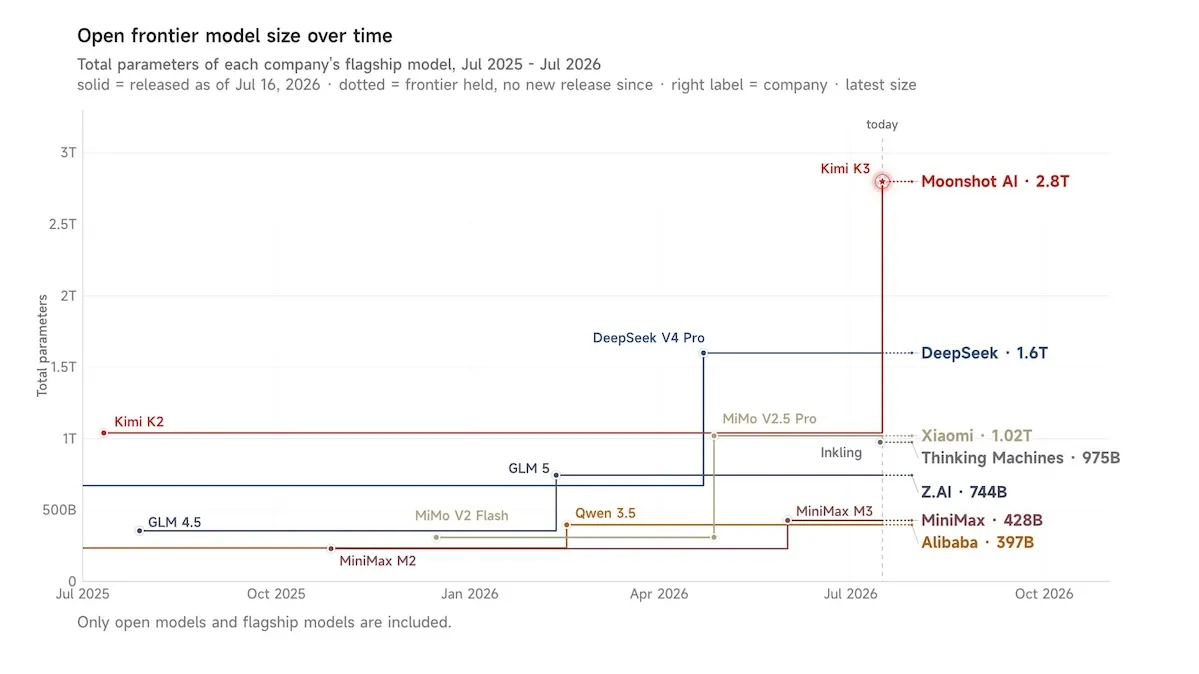
Kimi K3 is a broader open model that extends the frontier in several directions. It offers a longer context window, stronger multilingual capabilities, and better support for agentic workflows where a model must maintain state across multiple tool calls.
What sets Kimi K3 apart in the open models comparison is its ability to handle long documents without losing track of earlier instructions. Teams working on document summarization, codebase analysis, or research assistants will appreciate the larger context capacity. It is also more flexible when it comes to fine-tuning, with solid support for parameter-efficient methods like LoRA.
Kimi K3 represents the frontier for teams that need one model to handle many different tasks without maintaining a zoo of specialized models. It is not as fast as Inkling or as deeply reasoned as Laguna S2.1, but it covers a wider surface area with a reasonable balance of speed, cost, and capability.
Kimi K3 vs DeepSeek: A Head-to-Head Open Models Comparison
Architecture and Training Differences
DeepSeek v3 and DeepSeek r1 are two well-known open source AI models that have shaped the conversation around efficiency and reasoning. DeepSeek v3 is a Mixture-of-Experts architecture with a large total parameter count but a much smaller active parameter set during inference. DeepSeek r1 builds on this foundation with an additional reinforcement learning stage designed to improve chain-of-thought reasoning.
Kimi K3, by contrast, appears to emphasize a dense architecture with strong long-context performance. The training approach favors instruction following and agentic behavior, making it particularly useful for multi-step workflows. Where DeepSeek models excel at math and code reasoning, Kimi K3 aims for broader reliability across conversational and document-heavy tasks.
Performance Benchmarks: Reasoning, Speed, and Context
Because benchmark numbers change quickly, you should treat any static comparison as a starting point. But a rough comparison based on public model cards might look like this:
| Model | Context Window | Reasoning Strength | Inference Speed | Deployment Complexity |
|---|---|---|---|---|
| DeepSeek v3 | 128K | High | Fast with MoE | Medium (requires large VRAM) |
| DeepSeek r1 | 128K | Very High | Slower due to reasoning tokens | Medium |
| Kimi K3 | 256K (reported) | High | Moderate | High for self-hosted |
In practice, DeepSeek r1 produces longer reasoning traces, which increases latency but improves accuracy on complex problems. Kimi K3 offers a much larger context window, which is critical for applications that process entire codebases or lengthy contracts.
Cost per Token and Deployment Complexity
Cost is where the frontier gets interesting. DeepSeek models are known for their competitive API pricing, and because they are open-weight, you can also self-host them. However, self-hosting a Mixture-of-Experts model like DeepSeek v3 requires significant GPU memory, even though only a fraction of parameters are active per token.
Kimi K3, depending on the exact release, may require even more careful deployment planning due to its dense architecture and long-context memory demands. This makes a managed API more attractive unless your team has dedicated infrastructure expertise.
Where the DeepSeek API Fits In
For teams that want the power of DeepSeek without the operational burden, Mydeepseekapi provides a zero-setup path. It exposes DeepSeek v3 and r1 through a simple API, so you can start building immediately without provisioning GPUs or managing inference servers.
Mydeepseekapi emphasizes transparent pricing and fast response times, which matters when you are running production AI applications. Instead of guessing how many GPU nodes you need or worrying about flash attention kernels, you get a predictable per-token cost and a scalable endpoint. It is an attractive middle ground between fully self-hosted open source AI models and expensive proprietary APIs.
Open Models Comparison: Benchmarking Beyond Raw Scores
Latency vs. Accuracy: The Real Pareto Tradeoff
Most public benchmarks measure accuracy in a controlled environment with a single query. Real production systems run under load, with concurrent requests, streaming outputs, and strict latency budgets. The model that looks best on a leaderboard can collapse when you measure p95 latency across a thousand concurrent users.
The right way to evaluate open models is to build a load test that mirrors your actual traffic. Measure throughput in tokens per second, time-to-first-token, and error rates under sustained load. In several projects, we have seen a smaller model with 5% lower accuracy outperform a larger model in overall user satisfaction because it responded twice as fast.
Context Length and Multimodal Flexibility
Context length is another hidden frontier. A longer context window is not just about fitting more text; it affects how the model attends to relevant information. Some models with large windows still suffer from "lost in the middle" problems, where details in the middle of a long document are ignored.
When comparing open source AI models, test with your own long documents. Place critical facts in different positions and see whether the model retrieves them reliably. Multimodal flexibility is equally important if your pipeline includes images, PDFs, or audio. Not every open model supports these inputs well, and some require significant preprocessing.
Community, License, and Fine-Tuning Support
A model is more than its weights. The ecosystem around it determines how fast you can move. Look for an active community, clear licensing, and mature tooling for fine-tuning and inference.
Apache-2.0 and MIT licenses give you the most commercial freedom. Permissive licenses from model providers reduce legal friction. Community support matters when you encounter a strange runtime error or need advice on quantization. Models with a large user base often have more tutorials, more container images, and better integration with frameworks like vLLM or SGLang.
Real-World Implementation: Lessons from Production
When to Choose Laguna S2.1 for Reasoning-Heavy Workloads
Laguna S2.1 is the model we reach for when the cost of a wrong answer is high. In one project, a compliance team needed to extract obligations from legal contracts and map them to internal policy categories. Laguna S2.1 produced more coherent reasoning chains, which made it easier for human reviewers to verify the output.
If your workload involves multi-step diagnosis, code refactoring, or detailed financial analysis, Laguna S2.1 is worth the latency overhead. Just be sure to run it asynchronously so that slower responses do not block the user interface.
Deploying Inkling in Specialized Domains
Inkling is ideal for high-volume, narrow tasks. We have seen it used for medical claim coding, product categorization, and email triage. Because it is small and fast, you can deploy it on CPU-only instances with quantization and still get acceptable throughput.
The key to success with Inkling is to define the task boundary sharply. It will not handle open-ended queries, but it will outperform much larger models on structured outputs when the domain is well scoped. A common mistake is trying to use Inkling for everything because it is cheap. Use it for what it was built for, and route complex requests to a more capable model.
Scaling Kimi K3 in Existing AI Pipelines
Kimi K3 fits well into existing pipelines that require long-context understanding. For example, a research assistant that ingests multiple PDFs and generates a literature review can benefit from Kimi K3's larger context window. The integration pattern is straightforward: feed the model a document, let it generate structured notes, and then use a smaller model for final formatting.
When scaling Kimi K3, pay attention to memory consumption during the attention phase. Long prompts consume significant VRAM. Use batching and prompt caching if your inference framework supports it. Also monitor API stability if you are using a hosted version, especially during long-running agent loops.
Common Pitfalls to Avoid with Open Source AI Models
The most common pitfall is benchmark overfitting. Do not choose a model solely based on a public leaderboard. Those scores are often measured with specific prompts and sampling settings that do not match your production environment.
Another pitfall is ignoring hidden infrastructure costs. A "free" open source model can become expensive when you factor in GPU instances, engineering time, and ongoing maintenance. Finally, watch out for latency ceilings. A model that delivers beautiful answers in ten seconds may be useless for a customer-facing chat application. Set your latency budget before you evaluate models, not after.
When to Use Open Models (and When Not To)
Pros and Cons at a Glance
Open source AI models offer customization, transparency, and data privacy. You can fine-tune them, audit their behavior, and run them on your own infrastructure. The drawbacks are equally real: you take on maintenance, security, and operational responsibilities.
| Open Models | Managed APIs |
|---|---|
| Full control over weights and deployment | Zero infrastructure setup |
| Lower marginal cost after initial investment | Higher per-token cost |
| Data stays on your infrastructure | Data may leave your environment |
| Requires ML engineering expertise | Simple integration via REST |
A Decision Framework for AI Teams
Start by asking three questions. Do you have data privacy requirements that prevent sending data to a third-party API? If yes, open source AI models are likely your only option. Can your team handle inference infrastructure? If you lack GPU expertise, a managed API like Mydeepseekapi is safer. Do you need to fine-tune the model? If your domain is highly specialized, open weights are essential.
For most teams, a hybrid strategy works best. Use a managed API for prototyping and a self-hosted open model for production when volumes grow. That way, you keep the flexibility to move between frontier models without being locked into a single vendor.
What the Experts Say: Best Practices for Open Source AI Models
Reading Model Cards and Official Documentation
A model card is your first source of truth. It should describe the training data, evaluation methodology, known failure modes, and licensing terms. Read it carefully and do not rely on external blog posts alone. Official documentation also provides guidance on context length, recommended sampling parameters, and hardware requirements. When a model card mentions limitations, assume those limitations will appear in your workload.
Building Custom Evaluation Suites
Public leaderboards are useful for orientation, but they are not sufficient for procurement decisions. Build a custom evaluation suite with examples that accurately reflect your production traffic. Include edge cases, long-tail inputs, and adversarial examples. Measure not just accuracy, but also format compliance, hallucination rate, and latency under load.
A simple evaluation harness can be built with a few hundred examples. For each prompt, record the model output, score it automatically or manually, and compare responses across models. This process will often reveal that a model ranked lower globally performs best on your specific task distribution.
Avoiding Common Benchmark Traps
Be aware of data contamination. Some models have seen benchmark questions during training, which inflates their scores. You can mitigate this by creating your own evaluation set and keeping it private. Also watch for cherry-picked results. Model releases often highlight the best configuration, but that configuration may not be reproducible in your environment. Finally, ensure evaluation settings match your use case: same temperature, same prompt template, and same token limits.
How Mydeepseekapi Makes Open Models Production-Ready
Zero-Setup DeepSeek API Integration
Mydeepseekapi turns DeepSeek v3 and r1 into a production-ready service without requiring you to manage infrastructure. You get an API endpoint, an API key, and immediate access to the models. This is ideal for startups that want to validate an idea quickly with frontier-quality open source AI models.
The integration experience is smooth. The API is OpenAI-compatible, which means you can swap out your existing provider by changing a base URL. This reduces migration friction and lets you test different models without rewriting your application logic.
Transparent Pricing and Blazing-Fast Response Times
One of the biggest concerns with self-hosting open models is cost uncertainty. GPU failures, scaling events, and engineering overhead all eat into your budget. Mydeepseekapi addresses this with transparent per-token pricing and fast response times. You know what you are paying for, and the infrastructure is already optimized for performance.
For applications that need consistent latency, this is a significant advantage. You avoid the cold-start problem and the complexity of auto-scaling. Instead, you focus on building features while the API handles the heavy lifting.
Powering Apps with DeepSeek v3 & r1
Developers can move from prototype to production in a single afternoon using Mydeepseekapi. Start with a simple chat completion call, then add streaming, tool calling, and structured output. Because DeepSeek r1 is optimized for reasoning, you can use it for complex coding assistants and data analysis agents without building your own inference stack.
The combination of open weights and a managed API gives you the best of both worlds: the flexibility to switch to self-hosting later if needed, and the convenience of a production-ready endpoint today.
What’s Next on the Open Models Pareto Frontier
Emerging Open Artifact Trends
The next wave of open source AI models will likely focus on specialization and efficiency rather than raw parameter count. We will see more models like Inkling that are built for narrow domains, and more reasoning-first models like Laguna S2.1 that prioritize correctness. The cost curve will continue to tighten, with smaller models achieving performance that was once possible only with massive clusters.
Implications for Builders and Enterprises
Enterprises should prepare for a future where the frontier moves quickly. Build a model abstraction layer in your application so you can swap models without rewriting everything. Invest in evaluation infrastructure early, because the ability to test new models quickly will become a competitive advantage. And keep an eye on managed API solutions like Mydeepseekapi, which lower the barrier to using frontier open source AI models while preserving the freedom to adapt.
The Pareto frontier in AI is not a fixed target. It shifts every time a new open artifact is released. The teams that thrive will be those that learn to navigate that frontier with rigorous evaluation, practical deployment strategies, and a clear understanding of the tradeoffs. Open source AI models are winning because they give those teams the tools they need to make the tradeoffs themselves.